Business Optimization with the Strategy Pattern in Python: Practical Application with Dynamic Discounting

Definition
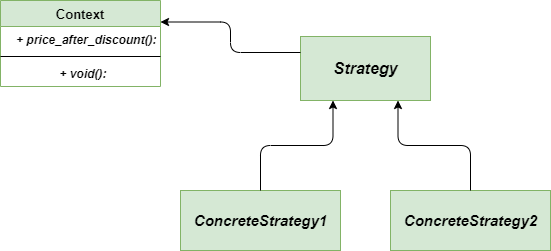
The Strategy pattern allows defining a family of algorithms, encapsulating each one, and making them interchangeable. This way, the behavior of an object can be modified dynamically without altering its internal structure. It is especially useful in business contexts where business rules must change in real-time, such as discount systems, commissions, or pricing.
Example in Python
Below is an implementation of the Strategy pattern to apply different types of discounts based on the type of client:
from abc import ABC, abstractmethod

# Base strategy
class DiscountStrategy(ABC):
    @abstractmethod
    def apply_discount(self, amount: float) -> float:
        pass

# Concrete strategies
class RegularDiscount(DiscountStrategy):
    def apply_discount(self, amount: float) -> float:
        return amount * 0.95

class VIPDiscount(DiscountStrategy):
    def apply_discount(self, amount: float) -> float:
        return amount * 0.85

class CorporateDiscount(DiscountStrategy):
    def apply_discount(self, amount: float) -> float:
        return amount * 0.75

# Context
class DiscountContext:
    def __init__(self, strategy: DiscountStrategy):
        self._strategy = strategy

    def set_strategy(self, strategy: DiscountStrategy):
        self._strategy = strategy

    def get_discounted_price(self, amount: float) -> float:
        return self._strategy.apply_discount(amount)

# Example usage
if __name__ == "__main__":
    amount = 1000
    context = DiscountContext(RegularDiscount())
    print(f"Regular: ${context.get_discounted_price(amount)}")

    context.set_strategy(VIPDiscount())
    print(f"VIP: ${context.get_discounted_price(amount)}")

    context.set_strategy(CorporateDiscount())
    print(f"Corporate: ${context.get_discounted_price(amount)}")
Explanation
A common interface
DiscountStrategyis defined with the methodapply_discount.The classes
RegularDiscount,VIPDiscount, andCorporateDiscountimplement this interface, encapsulating different discount logics.The class
DiscountContextholds a reference to a strategy that can change dynamically using theset_strategymethod.
This allows new rules to be applied without modifying existing context code, favoring reuse and maintainability.
Automation with GitHub Actions
To ensure the code works correctly after each change, a CI automation can be used with GitHub Actions.
Workflow file (.github/workflows/python.yml):
name: Python CI

on:
  push:
    branches: [ main ]

jobs:
  build:
    runs-on: ubuntu-latest

    steps:
      - uses: actions/checkout@v3

      - name: Set up Python
        uses: actions/setup-python@v4
        with:
          python-version: '3.10'

      - name: Run script
        run: python strategy_discount.py
✅ This pipeline performs:
Repository checkout.
Sets up Python 3.10.
Executes the
strategy_discount.pyfile.
🎥 Watch code explanation on YouTube: https://www.youtube.com/watch?v=lC-fBlfUM8k
The full source code and workflow can be explored here:
https://github.com/jf2021070309/strategy-pattern-business-rules-python
Pattern Comparison
| Pattern | Language | Main Purpose | Key Benefit |
| Repository | Java | Abstract data access to keep business logic decoupled | Facilitates unit testing and switching data sources |
| Strategy | Python | Dynamically switch algorithms without modifying the context | Changes behavior at runtime |
| Unit of Work | Ruby | Manage a set of operations as a single transaction | Ensures consistency across multiple actions |
Conclusion
The Strategy pattern is a powerful tool to manage variable behaviors such as discounts, fees, or commissions. When applied in Python, it provides greater flexibility in business systems without sacrificing clarity or scalability. Moreover, compared with other patterns like Repository in Java or Unit of Work in Ruby, each one fulfills specific roles in enterprise software design, contributing to clean, efficient, and adaptable solutions.


